OPERATIONS AND FEEDSTOCK
Pyrolysis material balance: close the books before judging yield
A material balance asks where the feed went. It is the basic check against double counting oil, gas, char, steel, moisture, and losses. Published tyre studies show that products depend on feed and reactor conditions, so a worked example must remain an example.
Set the boundary
Choose the basis first: one batch, one hour, or one tonne of as-received feed. Define whether the boundary includes sorting, drying, shredding, the reactor, condensation, gas cleanup, and storage. Record whether water is part of the feed. Without a boundary, two balances can both look correct while describing different systems.
Use consistent mass units and distinguish measured streams from calculated closure. A practical stream list can include accepted tyre feed, removed non-tyre material, water, recovered steel, condensed liquid, solid carbonaceous material, non-condensable gas, wastewater or captured liquids, and an unresolved loss. The unresolved term should be visible; hiding it inside a product makes the result look better than the measurements support.
Material balance closure is a diagnostic, not a quality certificate. A high closure can still contain biased scales or misclassified streams. A low closure tells you to investigate sampling, carryover, condensation, vapour leaks, retained material, and moisture accounting.
A hypothetical example
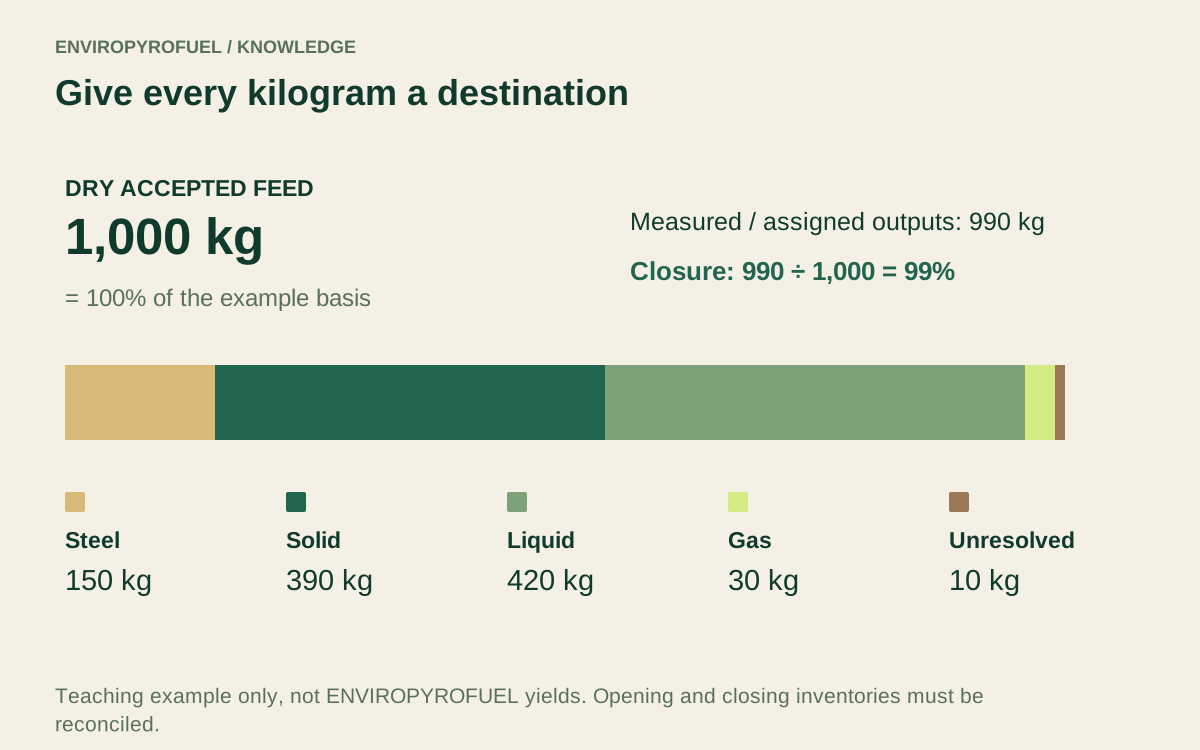
Consider a deliberately hypothetical basis of 1,000 kg of dry, accepted tyre feed. Assume the measured or assigned outputs are 150 kg recovered steel, 390 kg solid product, 420 kg condensed liquid, and 30 kg non-condensable gas. The outputs sum to 990 kg, leaving 10 kg as an unresolved balance difference. Closure is 99.0 percent, calculated as 990 divided by 1,000.
These numbers are arithmetic for teaching the method. They are not Enviro Pyro Fuel yields, a guarantee for any plant, or a target for a buyer. The example also assumes dry feed and a boundary that excludes upstream rejects. Change the moisture or boundary and the interpretation changes.
A useful next step is to repeat the balance on an as-received basis. If the same truck brings 1,050 kg containing 50 kg water, the dry tyre basis remains 1,000 kg, but the receiving and thermal duties must account for the water. Mixing the two bases is a common source of false yield claims.
Example decision
If a product ledger reports 1,020 kg from a 1,000 kg feed, do not call it a recovery success. Check whether steel was counted once at discharge and again in the solid product, whether water was included in one stream, or whether inventories changed during the run. If the 10 kg difference in the hypothetical balance persists across runs, investigate it before using the products for commercial forecasting.
The takeaway is to publish the basis, boundary, stream definitions, measurement method, and closure alongside any yield. A balance earns trust by showing what is unknown as clearly as what is known.
Investigate closure
Compare closure by run and stream. A change after a new scale, sampling point, or condenser configuration is a clue. Keep a change log for feed preparation, maintenance, calibration, and product handling so process changes are not mistaken for random variation. Do not force every difference into evaporation; check carryover, retained inventory, and misclassification first.
A balance should also show inventory at the beginning and end of the period. Liquid in pipework, solids awaiting discharge, and gas-holder changes can otherwise appear as production or loss. Publish unresolved difference with its sign and basis so a reader can see whether the account closes.
What an inventory adjustment changes
Suppose a liquid tank starts a measurement period with 300 kg and ends with 500 kg, while 800 kg is dispatched during the period. With no other liquid movements, net liquid entering that tank is 1,000 kg: 800 dispatched plus the 200 kg inventory increase. Reporting dispatch alone would understate that flow by 200 kg. These are illustrative accounting numbers, not product yields.
An apparent closure error can therefore arise even when every dispatched load is weighed correctly. Choose a period for which opening and closing inventories can be estimated consistently. Record which measurements were direct and which used tank level and density. Their uncertainty remains part of the balance rather than disappearing when the spreadsheet adds up.
Sources and further reading
Sources support the principles discussed here. Worked examples and decision checklists are explanatory; they do not report ENVIROPYROFUEL plant performance or product specifications.
- Demonstration of the waste tire pyrolysis process on pilot scale in a continuous auger reactor
- Flash pyrolysis of waste tires in an entrained flow reactor: an experimental study
- Pyrolysis as a potential approach to waste tire management
Apply testing, handling and operating decisions to the actual material, equipment and local requirements. A standards reference identifies a method or framework; it does not establish certification.