PROCESS SCIENCE
From a laboratory result to industrial performance
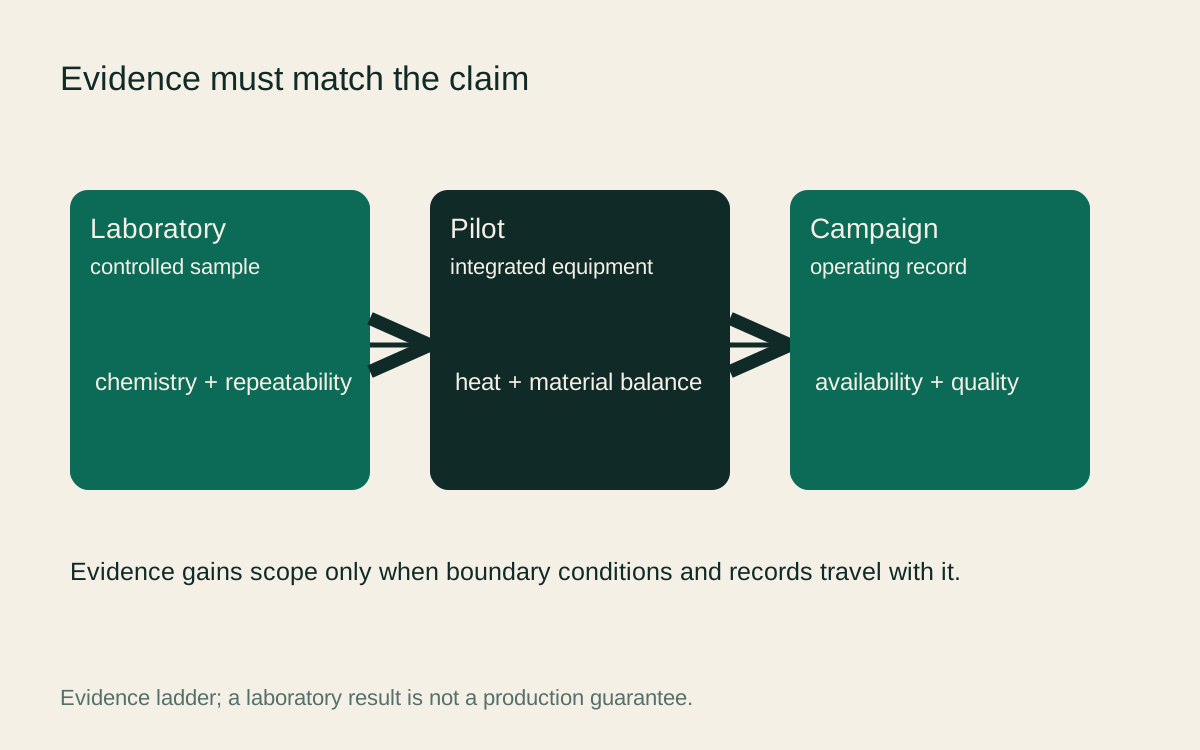
A successful laboratory experiment can establish that a conversion route works under the conditions tested. Deciding whether it will work reliably in a tyre processing plant requires evidence about a much larger system.
Read the experiment before the headline
Start a research paper by finding the question the authors tested. They might be comparing catalysts, measuring how rubber decomposes, or examining a particular liquid fraction. That question sets the boundary of the result. An experiment designed to compare two catalysts does not necessarily measure the cost of maintaining a complete plant.
Make a short record of the feed, equipment scale, operating conditions and collection method. For tyre research, distinguish a selected rubber component from a mixed tyre feed. Check whether the experiment includes steel, textile reinforcement and the mineral ingredients found in the incoming material. A carefully prepared sample can be appropriate for studying chemistry, while representing only part of a commercial feed.
The following questions apply technology assessment principles to tyre pyrolysis; they are an evaluation method, not claims about ENVIROPYROFUEL equipment. Keep the paper’s measured result separate from any proposed application. If a paper reports a promising liquid composition, the application still needs its own handling and use qualification.
References: 1
Maturity describes demonstrated conditions
The US Department of Energy uses technology readiness levels to distinguish laboratory validation from demonstrations in more representative environments. Its definitions ask for an explanation of the assigned level and the evidence needed for the next stage. A level is therefore meaningful only when its assessment boundary and supporting results are visible.
For example, a reactor component may have substantial test history while a newly combined reactor, condenser and gas system has much less. Ask which system the maturity statement covers. A proven component does not supply missing evidence about its new interfaces.
NASA’s Earth Science Technology Office also connects readiness stages to documented test results, the intended environment and scaling requirements. Its criteria are written for its own application domain. They illustrate the need for documented evidence, but should not be copied onto a tyre plant as though NASA had assessed it.
A campaign answers a different question from a run
Consider a hypothetical comparison. Trial A records three successful four-hour periods using prepared feed. Trial B records 120 elapsed hours using the intended feed range, including planned shutdowns and cleaning. Trial A supplies 12 hours of observations; Trial B supplies a longer operating history. Neither number, by itself, tells us which system is better.
Suppose Trial B processed material for 90 of those 120 hours. Its processing-time fraction is 75% for that campaign, using that specific definition. It is not automatically an annual availability figure: the period may be too short to include infrequent failures or seasonal conditions. Comparing its total output with Trial A’s best hourly rate would mix two different measurement boundaries.
A useful campaign record retains the interruptions as well as the stable periods. It connects each interruption to a reason, the recovery work and the time required. The lesson from this illustrative calculation is to ask how the observation window was chosen before using a rate in a capacity forecast.
Look for evidence that can be checked again
For an industrial evaluation, agree in advance what the trial should demonstrate. Record the configuration and conditions actually used, then retain results that did not meet the target. If feed preparation changes between trials, that change belongs beside the result. Otherwise a reader may attribute an improvement to the reactor when several conditions changed together.
- Define the feed range and the equipment included in the assessment.
- State the observation period and how start-up, cleaning and interruptions are counted.
- Keep sample identities connected to operating records and laboratory reports.
- Explain exclusions, missing observations and any changes made during the trial.
- Identify the next unresolved question and the evidence that would answer it.
Technical success still needs a receiving market
DOE’s adoption readiness framework separates technical progress from other deployment questions, including customer fit, supply chains and workforce availability. That distinction matters for recovered materials. A process can produce a consistent stream while the proposed customer still needs qualification trials, a suitable delivery format or a different specification.
When reading a pyrolysis result, write two conclusions: what the experiment demonstrates, and what remains to be demonstrated for the proposed application. This preserves the value of good research without making it carry a plant-performance promise it did not test.
References: 3
Sources and further reading
Sources support the principles discussed here. Worked examples and decision checklists are explanatory; they do not report ENVIROPYROFUEL plant performance or product specifications.
- US Department of Energy: Technology Readiness Levels
- NASA Earth Science Technology Office: Technology Readiness Levels and evidence criteria
- US Department of Energy: Adoption Readiness Levels
Apply testing, handling and operating decisions to the actual material, equipment and local requirements. A standards reference identifies a method or framework; it does not establish certification.