PROCESS SCIENCE
How tyre pyrolysis works
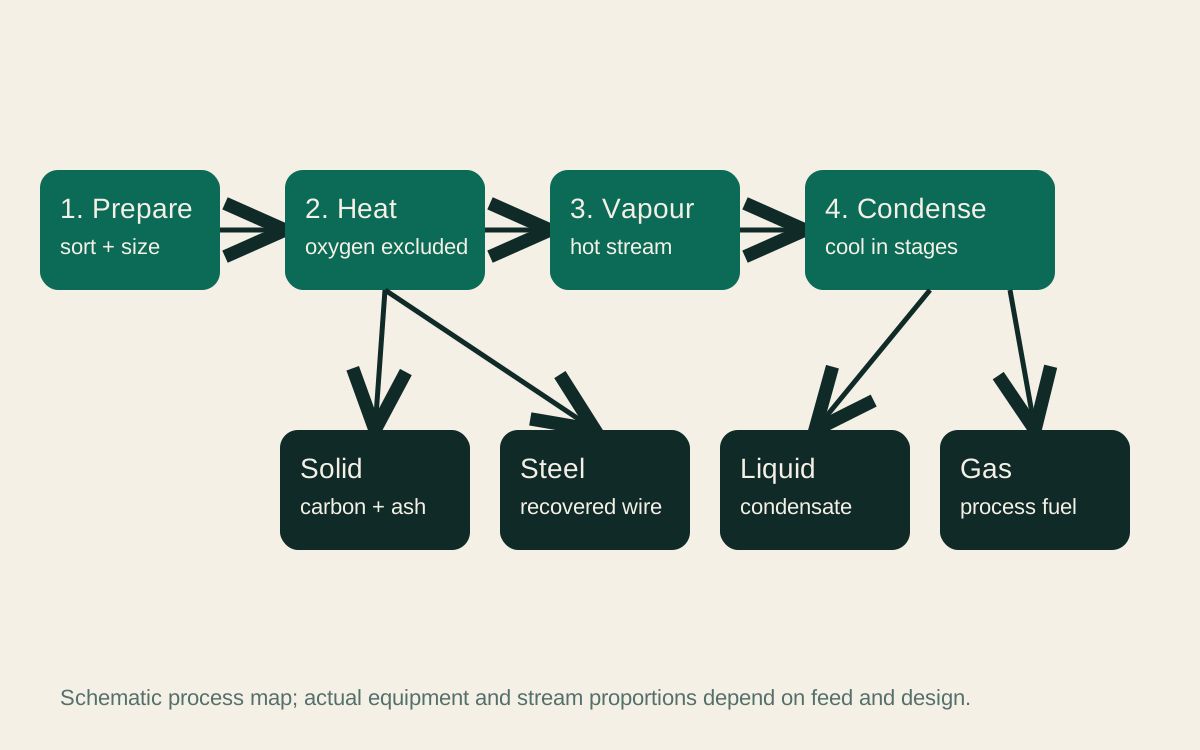
Tyre pyrolysis heats rubber in a reactor with oxygen kept out of the reaction zone. The polymer chains break into smaller molecules, some leave as vapour and some remain as a carbon-rich solid. After the vapour leaves the hot reactor, cooling separates condensable oil from gas that stays gaseous. Steel reinforcement is recovered as a separate solid stream. That sequence sounds simple, but the quality of each stream depends on feed preparation, heat transfer, vapour residence time and condensation. A tyre is a formulated composite, so pyrolysis is a controlled separation problem rather than a single reaction with one fixed yield.
From whole tyre to prepared feed
A plant normally begins by removing loose dirt, checking for non-tyre objects and reducing the tyre to a size the reactor can heat evenly. Steel may be removed before processing or recovered from the solid residue afterward. Textiles and mineral fillers travel with the feed unless a preparation step separates them. These choices change the mass balance. A laboratory result from clean rubber granules cannot be transferred directly to whole passenger tyres because the steel, fabric, ash and moisture have different heat and material behaviour.
The prepared feed enters a sealed vessel or a continuously fed reactor. The engineered start-up procedure establishes oxygen exclusion before heating. Oxygen exclusion matters because oxygen changes the operation into oxidation or combustion, raises the heat release, and changes the products. The pressure range belongs to the specific reactor design; oxygen exclusion in the reaction zone defines the core pyrolysis step.
References: 1
What happens in the hot zone
Rubber contains long, cross-linked hydrocarbon molecules. As temperature rises, bonds in the polymer network and sulphur cross-links break. The products include light gases, intermediate vapours and a solid made from carbon black, ash and less volatile material. Natural rubber, styrene-butadiene rubber and butyl rubber do not crack at exactly the same rate. Additives also release or transform sulphur-, nitrogen- and oxygen-containing compounds. This is why feed formulation and temperature history matter as much as the name ‘waste tyre’.
Heat transfer controls the real reaction temperature. A thermocouple in a furnace wall does not prove that the centre of a thick tyre piece has reached the same temperature. Large pieces can produce a hot surface and a cooler core, extending the time needed for conversion. Smaller particles heat faster, but grinding consumes energy and creates handling dust. The engineering decision is therefore a balance between uniform heating, preparation cost and reactor throughput.
Cooling turns vapour into products
Hot vapour leaving the reactor contains molecules with a wide range of boiling points. The condenser removes heat so part of that stream becomes liquid. A second cooling stage can recover lighter condensables that escape the first stage. The remaining non-condensable gas can contain hydrogen, carbon oxides, methane and other hydrocarbons, with composition changing with feed and operating conditions. Gas may be burned in a controlled process heater, but it still needs pressure control, flame protection and analysis before use.
The solid residue is cooled and separated from steel. It is often called tyre char or pyrolysis carbon, but that label does not make it equivalent to a virgin carbon black grade. Ash, zinc compounds, residual volatiles and surface chemistry affect its use. Oil also needs testing for water, sulphur, acidity, viscosity and distillation range before anyone selects a burner, boiler or upgrading route.
A useful way to read a process result
Suppose a trial reports oil, gas and solid percentages. First ask whether the percentages use the total tyre mass or only the rubber fraction. Then ask whether steel and textile were included, how long vapours stayed hot, and whether the oil was measured after water removal. Two apparently conflicting results can both be correct if their feed and measurement bases differ. A sound report states the feed composition, particle size, temperature profile, residence times and product definitions.
For a plant decision, follow the material streams and heat duties behind the headline yield. A balanced trial should weigh the prepared feed and every recovered stream, record uncondensed gas, and account for deposits and losses. Product specifications and emissions controls decide whether a stream is usable. Pyrolysis supplies a route for separation; testing and operating discipline determine what the separated materials can do.
A useful commissioning record also separates measured facts from calculated estimates. Record the scale reading, gas analyser basis, receiver temperatures and sampling time. If a stream is estimated from a difference, label it as a difference and carry the uncertainty forward. This helps operators find leaks and hold-up, and stops a provisional laboratory balance from becoming an operating promise. The same record gives a later designer enough information to decide whether a change belongs in feed preparation, the hot zone or the condenser.
Sources and further reading
Sources support the principles discussed here. Worked examples and decision checklists are explanatory; they do not report ENVIROPYROFUEL plant performance or product specifications.
- Martínez et al.: Waste tyre pyrolysis — A review
- Pyrolysis of Tyre Waste in a Fixed-Bed Reactor
- De Marco Rodriguez et al.: Pyrolysis of scrap tyres
Apply testing, handling and operating decisions to the actual material, equipment and local requirements. A standards reference identifies a method or framework; it does not establish certification.