PROCESS SCIENCE
Batch and continuous pyrolysis
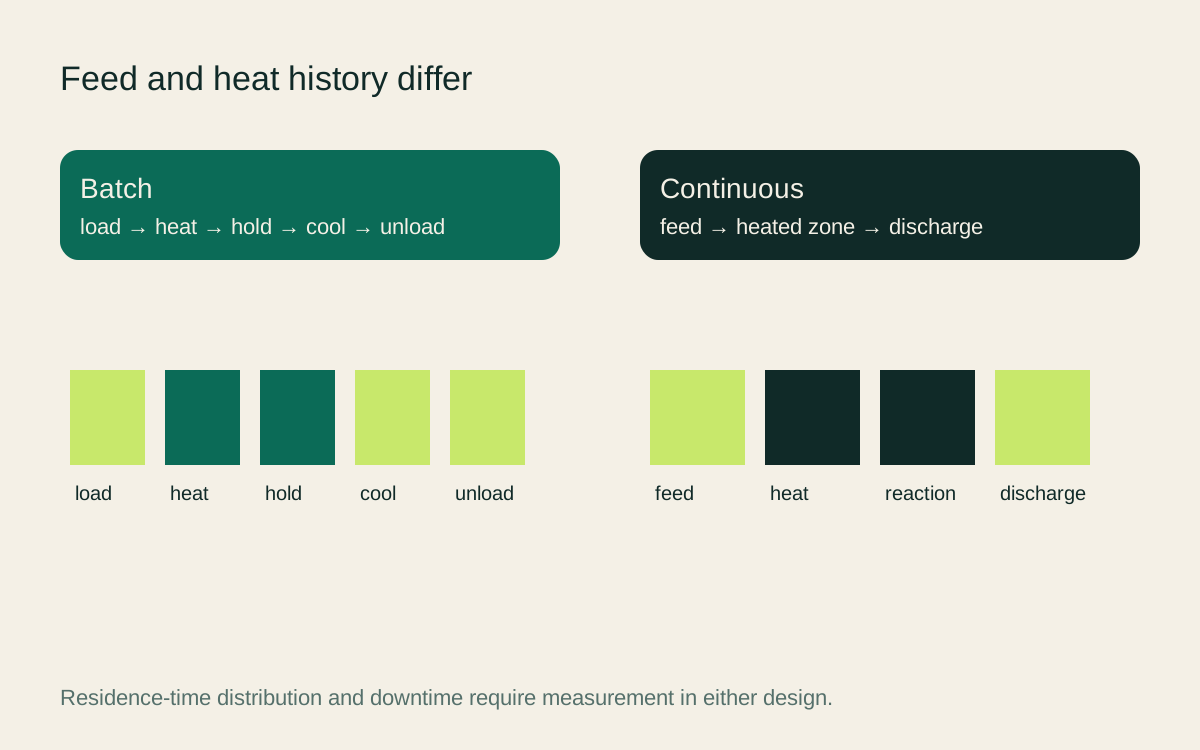
A batch reactor is loaded, heated, held and emptied. A continuous reactor receives prepared feed and removes solids and vapours during operation. Both can pyrolyse tyres, but they expose the feed to different heat histories and create different operating tasks. Batch equipment makes campaign changes and inspection straightforward. Continuous equipment can provide steadier flow, but feed metering, seals, solids discharge and vapour routing must work together without frequent interruption.
What a batch cycle contains
A batch cycle starts with loading and closing the vessel, followed by purge, heating, reaction, cooling and unloading. The first and last parts do not produce the same vapour history as the middle of the cycle. Heating a dense load can take longer than the furnace temperature suggests, and vapours released early may see a different condenser temperature from vapours released late. A reported cycle time therefore needs a definition: time at set temperature, time from ignition of heating, or time until gas flow falls below a criterion.
Batch operation can suit variable feedstock because an operator can inspect each load and change the recipe between cycles. It also creates downtime for cooling, opening and maintenance. Product tanks and gas systems must accommodate transient flow rather than assuming a constant rate.
References: 1
What continuous operation changes
A screw, rotary kiln or fluidised-bed reactor moves feed through a heated zone while conveying solids or maintaining suspension. The important measure is residence-time distribution: some particles spend less time in the reactor and some more. Feed size, fill level, screw speed, gas flow and deposits alter that distribution. The word continuous describes feed and discharge, not perfectly uniform conversion.
Continuous systems can recover heat from hot solids or recycle process gas to a heater. They need dependable upstream size reduction and a controlled feed rate. Bridging, screw wear, air ingress at seals and carbon deposition can disturb operation. Instrumentation should track reactor temperatures at several locations, pressure, gas composition and the mass flow of feed and products.
References: 2
The comparison trap
A batch study may report product percentages after a long hold at temperature, while a continuous study reports steady-state flow after startup. Their nominal temperatures can match while their vapour residence times do not. One may use steel-free rubber and the other whole tyres. These differences can change oil composition and gas yield more than the reactor label itself.
A fair comparison records feed basis, particle size, heating rate, reactor temperature profile, vapour residence time, pressure, condenser train and whether results are on a dry, ash-free or received basis. Include startup and shutdown losses when discussing plant throughput. Laboratory selectivity and plant availability are separate measurements.
Choosing for the job
If feed arrives in irregular lots and the project values simple campaign changeover, batch operation may be easier to manage. If the project has a stable prepared feed and needs steady downstream flow, continuous operation may be a better engineering fit. Neither choice removes the need for gas safety, condensate handling, char cooling and emissions control.
The useful decision is a run sheet with measured rates. For each trial, record kilograms per hour, time at steady state, energy used, unplanned stops and product quality. A high instantaneous yield during a short batch can be less useful than a slightly lower yield that remains stable for a long continuous run. Reliability is part of process performance.
Availability should be reported beside yield. A campaign that produces 100 kilograms of product during 20 hours but spends 8 hours loading, cooling and cleaning has a different daily output from a nominally identical 100-kilogram run with one hour of downtime. Include maintenance access, operator workload and safe isolation in the design review.
Startup and shutdown deserve their own balance. Cold equipment can hold condensate, hot solids can keep releasing gas, and an operator may need to divert unstable streams until temperatures settle. Record these periods and define where the material goes. A production number based only on the smooth middle of a run is useful for chemistry, but it is not the same as a daily operating rate.
Sources and further reading
Sources support the principles discussed here. Worked examples and decision checklists are explanatory; they do not report ENVIROPYROFUEL plant performance or product specifications.
- Pyrolysis of Tyre Waste in a Fixed-Bed Reactor
- Demonstration of the waste tire pyrolysis process on pilot scale in a continuous auger reactor
- The role of temperature profile during the pyrolysis of end-of-life-tyres in an industrially relevant conditions auger plant
Apply testing, handling and operating decisions to the actual material, equipment and local requirements. A standards reference identifies a method or framework; it does not establish certification.