MATERIAL QUALITY
Char and recovered carbon black are related, not interchangeable
Tyre pyrolysis leaves a carbon-rich solid. Recovered carbon black is a qualified material category that depends on feed, separation, processing and tests. The two terms should not be used as synonyms.
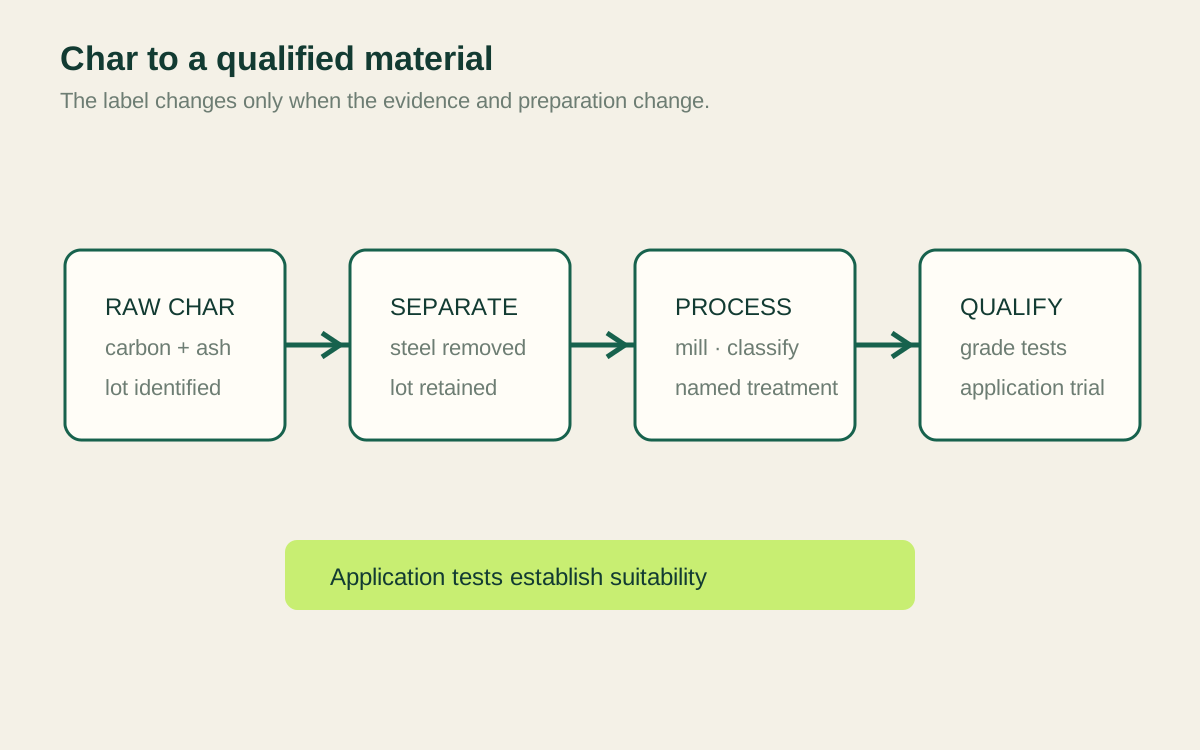
Name the material at the stage it is in
Raw tyre pyrolysis char is the solid residue collected after thermal treatment. It can contain carbonaceous material, mineral ash, residual steel or other inorganic components, and traces of material carried through the process. Its properties depend on tyre feed and operating history. A coarse black powder is not enough information to assign a market grade.
Recovered carbon black, often abbreviated rCB, describes a material that has been recovered and prepared for a specified use. The qualification may require controlled removal of metal, milling, classification, demineralisation or pelletising, followed by tests selected for the customer’s application. A product name should therefore identify the preparation state and grade.
Virgin carbon black is manufactured from other feedstocks under a controlled process and has its own grades and specifications. A customer comparing char or rCB with virgin carbon black should compare the properties needed in the formulation, not just colour. The replacement level, dispersion behaviour and reinforcement performance must be established for the actual compound.
| Material label | What it means | Evidence still needed |
|---|---|---|
| Raw char | As-collected carbon-rich solid residue | Ash, moisture, metal, sulfur, particle size and intended outlet |
| Processed char | Char after named physical or other treatment | Treatment record and before/after test data |
| Recovered carbon black | Qualified recovered carbon material for a defined use | Grade specification, lot results and application trials |
| Virgin carbon black | Manufactured carbon black grade | Manufacturer specification and formulation fit |
| Reject or off-grade solid | Material outside a stated requirement | Safe, authorised destination and traceability |
Which measurements establish suitability
Ash indicates inorganic residue, but its meaning depends on method and basis. Moisture affects handling and reported composition. Residual steel or other metal can damage milling equipment and alter a formulation. Particle-size distribution affects feeding and dispersion. Sulfur and extractable matter can matter in rubber or polymer applications. Surface area and structure can affect reinforcement, but they require a method and comparison grade.
ISO 9277:2022 specifies the BET gas-adsorption approach for determining specific surface area of solids. A BET result is one property, not a complete rCB grade. ASTM carbon-black methods cover particular properties and test conditions; a laboratory should confirm that a method is suitable for a recovered material before a buyer treats it as an equivalent grade.
Application testing completes the picture. A rubber compounder may test cure behaviour, tensile properties, abrasion and dispersion in its own formulation. A pigment or filler user may need different evidence. The acceptance test should be agreed before a sample is described as a commercial substitute.
Keep the claim narrow: “carbon-rich char, tested for the listed properties” is accurate when supported by the report. “Drop-in virgin carbon black replacement” requires a much stronger body of grade and application evidence. The customer’s own formulation remains part of that evidence.
A sensible qualification path
First identify the intended product and customer specification. Then separate steel and visible foreign material, mill or classify only in equipment designed for the dust and fire hazards, and test the resulting fraction. If a mineral reduction step is needed, its chemistry, waste stream and permits belong in the process design. This article does not provide acid or chemical recipes.
Send representative prepared material to an appropriately qualified laboratory. Ask for the method, basis, uncertainty or precision information where available, and sample preparation. Compare the report to the customer’s grade and run an application trial at an agreed loading. Record both successes and failures; one favourable test does not qualify every future batch.
A buyer should ask what fraction of the output is being sold, how lots are defined, how off-grade material is handled and which tests are repeated at release. A supplier should avoid presenting raw char data as rCB data. Clear names make commercial and safety discussions easier.
A recovered-carbon qualification conversation should begin with the proposed use, sample identity and required evidence. Final suitability depends on the customer’s formulation and the tested lot. Retained input and finished samples can help investigate a later dispute when they remain correctly identified and stored under the site’s quality controls. A qualification report should also state what the process did not establish: ash reduction does not establish low sulfur, and pellet durability does not establish rubber-compound performance. That boundary belongs on the certificate or release note, where later users can see it.
Sources and further reading
Sources support the principles discussed here. Worked examples and decision checklists are explanatory; they do not report ENVIROPYROFUEL plant performance or product specifications.
- ISO 9277:2022, Specific surface area of solids by gas adsorption, BET method
- ASTM D6556, Carbon Black — Total and External Surface Area by Nitrogen Adsorption
- Martínez et al., Waste tyre pyrolysis: A review
Apply testing, handling and operating decisions to the actual material, equipment and local requirements. A standards reference identifies a method or framework; it does not establish certification.