MATERIAL QUALITY
Ash, moisture and volatile matter measure different things
Ash, moisture and volatile matter are separate measurements. Each uses a defined portion of a sample and a defined test condition, so the three numbers should never be read as interchangeable descriptions of “purity.”
Three tests, three questions
Moisture asks how much water or other loss occurs under the method’s drying condition. It affects mass, flow, storage and the basis used for other results. A damp char may cake, generate dust differently after drying and deliver less dry material per weighed shipment.
Ash is the residue left after a specified ashing procedure. It represents non-combustible inorganic matter under that procedure, but it does not identify each mineral or prove that all visible metal was measured in the way a buyer expects. Ash can include mineral fillers and process residues; separate metal analysis or magnetic separation records may still be needed.
Volatile matter is the portion lost under a specified heating procedure after accounting for the method’s other steps. It is not the same as water, and it is not a direct measure of hydrocarbon value. The result depends on temperature, time, atmosphere, crucible and sample preparation. A method written for coal, biomass or another solid may not automatically be suitable for tyre char.
| Measurement | Question answered | Common interpretation error |
|---|---|---|
| Moisture | How much mass is lost in the stated drying step? | Treating it as all volatile hydrocarbon |
| Ash | What residue remains after the stated ashing step? | Calling all residue mineral identity or all contamination |
| Volatile matter | What mass is lost under the stated volatile-matter procedure? | Comparing results from different methods as if identical |
| Fixed carbon by difference | What remains after subtracting reported components? | Treating a calculated value as a direct carbon assay |
Basis and method control the comparison
A result may be reported as received, dry basis or another basis. If one char contains 8 percent moisture and another contains 2 percent, their as-received ash values cannot be compared directly to a dry-basis specification without conversion. Conversions should retain the original value, the stated basis and the equation used.
ASTM D3173 covers moisture in the analysis sample of coal and coke, while ASTM D3174 covers ash in the analysis sample. Their titles and scopes are a reminder that a method’s matrix matters. A laboratory should confirm applicability to tyre-derived char, use an agreed method or clearly qualify the result. ASTM E872 likewise describes a volatile-matter procedure for biomass fuels, not a universal test for every carbonaceous solid.
Sample preparation can change the result. A coarse sample may separate steel and mineral pieces from fine char. Grinding can improve uniformity but can also create heat or dust and alter the handling history. The report should state how the submitted sample was prepared, the portion tested and whether the result is a single determination or replicate average.
When a specification says “ash maximum,” ask for the method, temperature, atmosphere, basis and precision. When it says “volatile matter,” ask the same questions. A number without these fields is a starting point for clarification, not a pass.
Use the results in a material decision
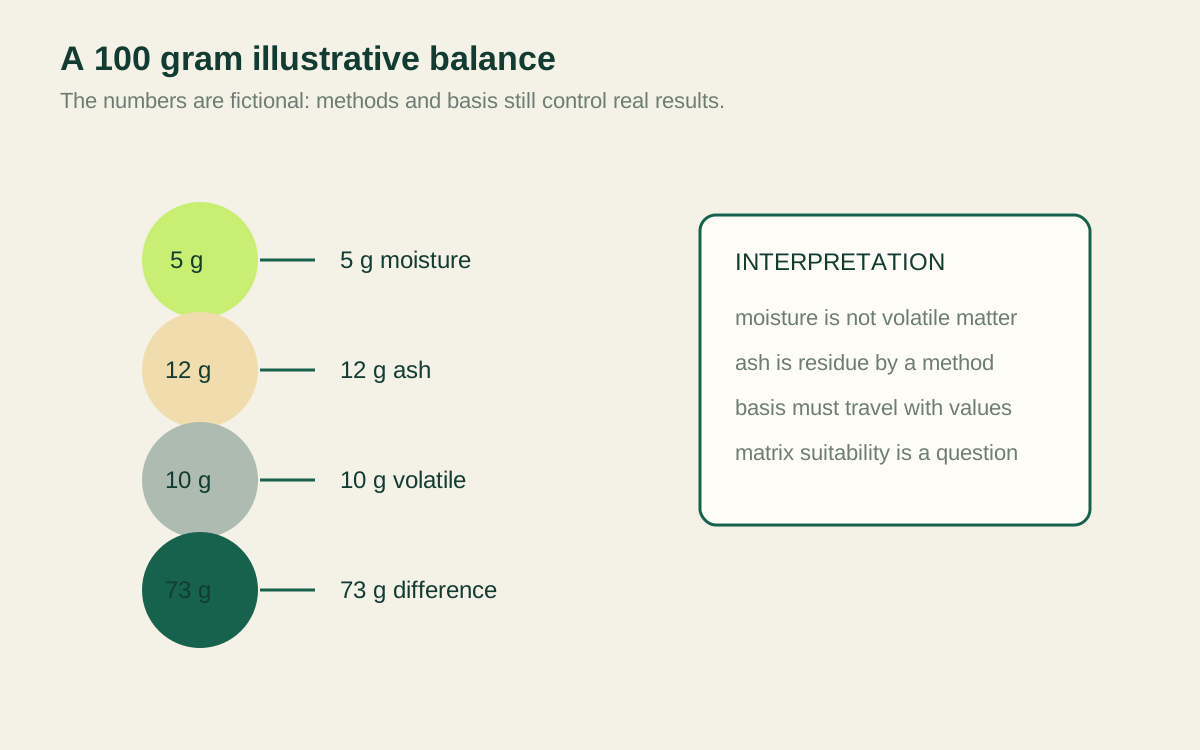
Suppose a char report shows 12 percent ash as received, 5 percent moisture and 10 percent volatile matter. Those figures do not add up to a product grade by themselves. The buyer still needs the method and basis, a carbon or elemental result if required, particle-size data, metal information and the application limit. If the agreed specification is on a dry basis, the as-received value must be converted correctly or retested on the required basis.
High moisture can point to storage or cooling history and may change shipment economics. High ash can reduce the carbon fraction and affect dispersion, surface properties or furnace behaviour. High volatile matter may reflect remaining organics or method response, but only a suitable procedure can support that interpretation. None of these results alone identifies a cause.
A useful release sheet pairs the result with a decision: accept for a named application, hold for method or basis clarification, condition and retest, or route to another authorised use. The record should state who made the decision and which specification was applied.
The customer and laboratory should agree the methods and limits before a char result is presented as a grade claim for the named application and lot.
- Keep as-received values beside converted values.
- Ask whether the method was validated or deemed suitable for tyre char.
- Separate measured ash from metal identity and contamination diagnosis.
- Do not infer a universal carbon percentage from three routine measurements.
Sources and further reading
Sources support the principles discussed here. Worked examples and decision checklists are explanatory; they do not report ENVIROPYROFUEL plant performance or product specifications.
- ASTM D3173/D3173M, Moisture in the Analysis Sample of Coal and Coke
- ASTM D3174, Ash in the Analysis Sample of Coal and Coke
- ASTM E872, Volatile Matter in the Analysis of Particulate Wood Fuels
Apply testing, handling and operating decisions to the actual material, equipment and local requirements. A standards reference identifies a method or framework; it does not establish certification.