
PROCESS SCIENCE
Temperature, heating rate and residence time
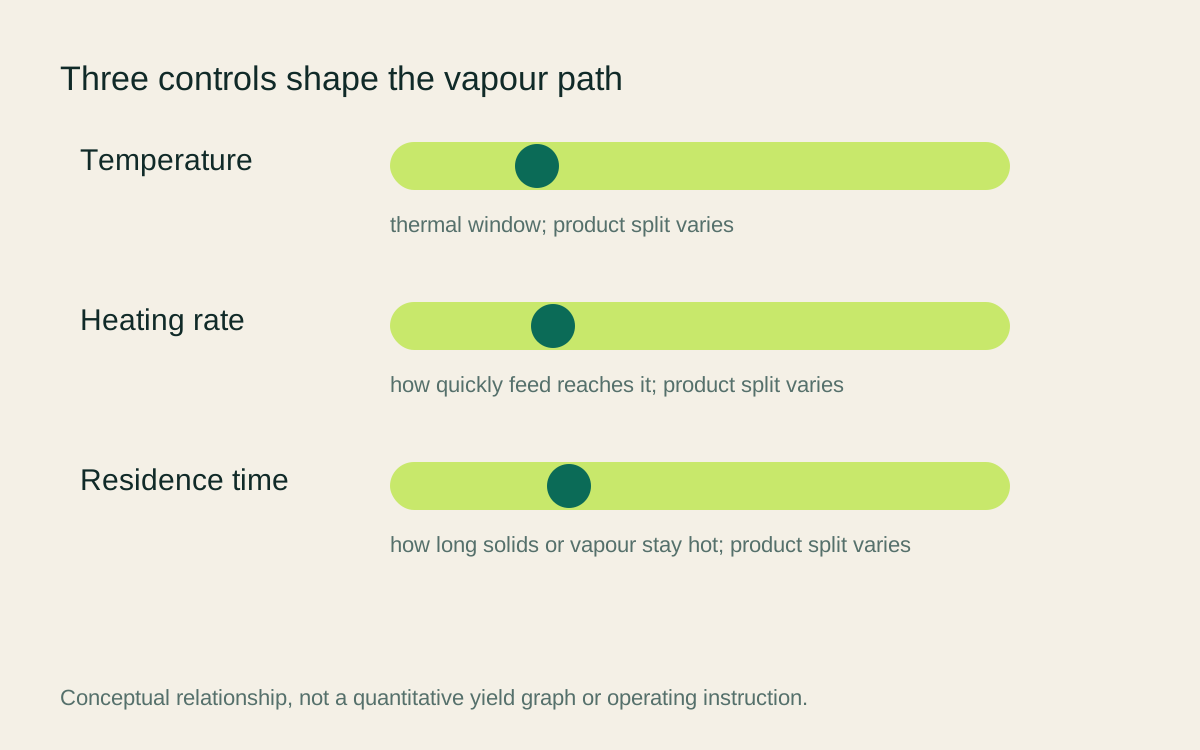
Temperature, heating rate and residence time are often listed together, yet each answers a different question. Temperature is the thermal condition reached by the reacting material. Heating rate is how quickly that material gets there. Residence time is how long solids or vapours remain in a zone. A trial that reports only one set-point leaves out much of the history that controls cracking, secondary reactions and condensation.
Temperature sets the reaction window
Tyre rubber decomposes over a range rather than at one switch point. Experimental studies use different temperature ranges for different reactors, feed preparations and product goals; the reported temperature belongs with those conditions. Higher temperature can drive more extensive cracking and increase light gas formation, while lower temperature can leave heavier vapours and unconverted material. The direction is a tendency, not a universal yield rule.
Measure temperature where the feed reacts. Wall, gas and particle temperatures can differ during heat-up. A thick piece can have a cooler centre than its surface. Pressure and vapour removal also affect the chemistry because products can react again before cooling. Any claimed optimum should therefore include the measurement location and the rest of the operating conditions.
References: 1
Heating rate controls the path
Heating rate changes how quickly bonds break and vapours escape. Rapid heating can release a burst of vapour and reduce the time that newly formed molecules spend on hot surfaces. Slow heating gives heat time to move inward and can expose intermediates to further reaction. Particle size, furnace design, agitation and gas flow all contribute to the effective rate seen by the tyre.
A simple comparison illustrates the issue. Heating two one-kilogram samples from 25 to 500 degrees Celsius in ten minutes and in sixty minutes gives the same final set-point but different thermal histories. The example says nothing about product yield by itself; it shows why ‘500 degrees’ is incomplete process information.
References: 2
Residence time has two meanings
Solid residence time is the time a tyre particle or char fragment spends in the hot reactor. Vapour residence time is the time released molecules remain hot before condensation. They can move in opposite directions: a screw may shorten solid time while a blocked outlet lengthens vapour time. Longer hot-vapour residence generally allows more secondary cracking and reactions that can change oil toward lighter gases or heavier deposits.
Condenser design sets the next residence time. Rapid quenching limits further reaction; a warm, overloaded condenser leaves vapour in the hot system and can increase fouling. Measure flow and pressure rather than assuming residence from a nominal pipe volume. Gas velocity changes as composition and temperature change.
References: 3
Use a matrix, not a magic number
For a development trial, vary one factor at a time only when interactions are small, or use a planned matrix that covers temperature, particle size and vapour handling. Record oil properties, gas composition, char ash and unconverted feed along with mass yield. A temperature increase that raises gas may be useful if gas supplies heat, but undesirable if the target is condensable liquid.
Publish the thermal history with the result. State heating rate, measured feed temperature, solid and vapour residence times, pressure and condenser temperatures. These details let another engineer interpret the result and reproduce the boundary conditions. A single optimum number without that context is not a design rule.
When interpreting results, distinguish correlation from cause. A higher oil yield may coincide with a smaller particle size, a different condenser load and a new feed lot. Repeat the comparison with the other variables held in range, and use product analysis to test the explanation. A modest, repeatable change is more useful for control design than a dramatic result from one unbalanced run.
A control room can use the same record to set alarms. A rising pressure, falling gas quality or widening temperature difference may indicate fouling or feed change before a product tank shows it. Alarm limits must come from the equipment and hazard review, but the principle is general: process variables are useful when operators connect them to a defined response.
Do not call a trial optimum until the measurement uncertainty and repeatability are visible. Duplicate runs with the same feed preparation can show whether a reported difference is larger than ordinary variation. Keep the raw temperature trace, analyser calibration record and weighing sheets with the result. This makes a useful boundary for scale-up without pretending that a small experiment has already proven commercial performance.
Sources and further reading
Sources support the principles discussed here. Worked examples and decision checklists are explanatory; they do not report ENVIROPYROFUEL plant performance or product specifications.
- Experimental Analysis of Temperature Influence on Waste Tire Pyrolysis
- Effect of high heating rates on products distribution and sulfur transformation during the pyrolysis of waste tires
- The role of temperature profile during the pyrolysis of end-of-life-tyres in an industrially relevant conditions auger plant
Apply testing, handling and operating decisions to the actual material, equipment and local requirements. A standards reference identifies a method or framework; it does not establish certification.